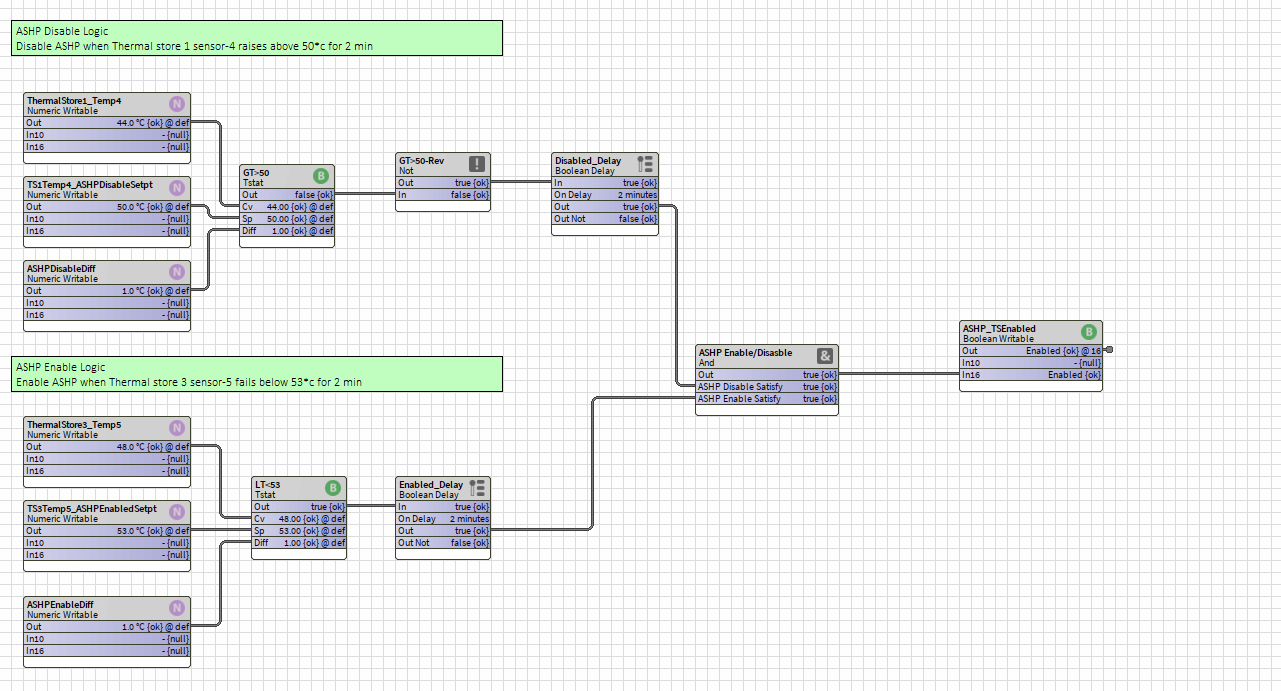
The lead ASHP is enabled when sensor 5 (from the top of the thermal store) of Thermal Store 3 falls below 53°C for 2 minutes – to be finalized during load test.
The lead ASHP is disabled when sensor 4 (from the top of the thermal store) of Thermal Store 1 rises above 50°C for 2 minutes – to be finalized during load test.
How can I implement an interlock in a Niagara 4 wire-sheet to ensure that both scenarios cannot operate simultaneously?
Maybe something like an AND block into the enable. For inA you need a LessThan block with the input from the sensor and the setpoint and a boolean delay. For inB, GreaterThan and a Not…or just use a LessThan again and boolean delay. That doesn’t give you any deadband…if you want that you could use Tstat blocks
The ASHP would be disabled…that is the sequence you described above. You can only send one command to the ASHP. By having the two conditions fed into an AND block, each would have to be met to enable the ASHP. If Sensor 5 > 53C (for 2 min) AND Sensor 4 < 50C (for 2 min) THEN enable ASHP. You’re flipping the condition for Sensor 5…you could also use a greater than and a NOT. My point was that there isn’t a deadband with this (other than the time condition), a tstat block would allow some deadband to better handle any fluctuation in the sensor readings
I think it looks good…kudos for going the extra mile and renaming the slots! That always makes it easier to troubleshoot in the future. Then just make sure you have histories on your individual conditions and the enable